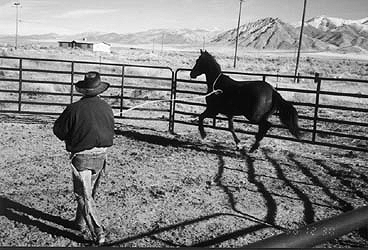
"Taking horsemanship one step farther"
with Jack Young
Click here to read a 2013 Clinic Report/Testimonial by Ash Wakeman
Clinic Photos
Trout Creek, Montana 2001
Coutts, Alberta 2001
Platteville, CO, 2003
Golden, CO, May 8-9, 2004
Eureka, NV, May 15-16, 2004
Beckwourth, CA, July 22-24, 2005 (For slideshow captions, click on "i" in middle of screen)
Winnemucca, NV, Aug. 4-5, 2007 (For slideshow captions, click on "i" in middle of screen)
Prices
Private session: $25/hr
Away from home: $35/hr plus $10/travel fee
Semi-private (2 people): $20/hr each
Home Clinic (3 or more): $90 each/day
Jack has passed on, but his approach--his knowledge, experience and teaching--is still available for anyone interested. Jan's goal is to diligently pass on what she has learned from Jack over the years.
For information, contact Jan at:
jnjyoung@hotmail.com
___________________________
ABOUT JACK
Jack trained and showed professionally, mostly working cow horses. He judged shows, both Western and English. A graduate of Cal Poly SLO, he also ran the horse unit at Fresno State for four years and coached the judging team. He had a training stabls in Fresno, California, and gave lessons to adults and children. His background included several years of cowboying in California and Nevada. He worked with Ray Hunt for several years in California and Nevada in Ray's pre-clinic days.
For an overview of concepts presented in clinics, see the article below, "Visiting About Horses.
_______________________________
__________________________
A STORY
A young cowboy was working some horses in a round corral. An old cowboy came by, watched for awhile, then asked, "Young man, would you like to know the secret of good horsemanship?" He said he would. The old man made a fist and said, "If you can open my fist, you will learn the secret of good horsemanship." The young guy poked, pried, thumped, pinched, squeezed, pushed, punched, and shoved the fist. He finally said, "I can't get it open. What's the secret of getting your fist open, so I can learn the secret of good horsemanship?" The old cowboy said, "You could have asked." (Source: unknown)
That pretty well explains most of the horsemanship we see going on all around us. Most of the time we are pushing, shoving, pulling, pounding, prying, and thumping. The one thing that we often neglect to do is to ask the horse. Asking would really improve the willingness of the horse to open up. We need to learn how to ask our horses.
EQUITATION
Imagine a hanger bent into a shape of a human, with a head, arms in front about shoulder-width, and legs hanging down. Imagine that the hanger-man is sitting on a horse, and looks off to the left and focuses. What happens to the hanger? The shoulders and hips turn, which cause the left leg to move back, giving pressure, and the right leg to move forward, giving pressure. If there are reins attached to the hanger-man's arms, with a snaffle bit, one rein gives slack and one tightens. When you turn, first you focus, then your legs should act, and your reins should act or support last.
You don't need to pull on the reins as much as most people think is necessary. Your legs, hips, and seatbones are much more important in how you handle a horse. When you think about how a roper's hands are busy handling coils of rope, or how people used to go to battle on horses, wielding swords or shields, you can see that a horse can be handled with very little reining. Another reason for doing less reining is that the reins are attached to a very tender part of the horse's body—the mouth. Staying off the mouth keeps the horse light. Let's talk about some ways we can use our legs and body to direct the horse.
We need to learn to sit up on our horses. One way to do this is to broaden our collarbones. That doesn't mean to push them out, because that will hollow out your back. Your posture should be relaxed, not stiff. You want to relax on a horse and "let" things happen. Especially relax the leg from the knee down. Your lower legs should be as relaxed as they are when you are sitting in a chair, with your feet on the floor. You don't push on the floor—your feet just set there. What happens when you push on your stirrups? Your legs get farther away from the horse. The farther your legs are from the horse, the less you can feel the horse, and the less the horse can feel you. If you are relaxed and not pushing on your stirrups, you will find that when you turn your head and shoulders (collarbones), your hips and legs will turn also. Your inside leg will go back a little and your outside leg will go forward a little, just like the hanger-man.
People want to spur back and to kick back, and turn their toes out. That is not necessary. You don't have to move your legs much on a horse. When you kick behind, that puts your body slightly forward. If the horse jumps forward, and then sucks back, you will go head first into the dirt. It's better to stay upright and balanced in the center, where you stand a better chance of staying with the horse if something goes wrong. Instead of kicking or spurring toward the back, move your foot by just bringing your ankle bone in. If you have to use your foot farther back, use your ankle bone.
An effective way to direct the horse with your body is with the "pelvic roll." Every little kid in the world can do this movement, but for some reason, it's hard to get adults to do it on a horse. It's the motion you use when you pump a swing. Notice how this motion sets you down on your pockets, instead of up on your thighs or your crotch. You can pump the swing straight forward or to the left or to the right. Another way to think about using your body to direct the horse is to imagine that you have a big pencil sticking out of your bellybutton. Point that pencil, point your bellybutton, the direction you want to go. Or imagine that you have a beam of light coming out of the top button of your shirt, and point that beam where you want to go. That will also help you not to slump in the saddle. It will make you sit up and broaden your collarbones. Look where you are going, or want to go, not down at the horse. As you are holding the reins, point your index fingers where you want to go--where you are focusing. He'll go where you are looking.
Ride both ends of the horse—the front end and the back end. Use your legs, your feet, your hands, your seatbones, your weight, your focus. The more you use your body, the less you have to use your hands on the horse's mouth, and your horse will stay light. Seatbones first, with legs, then reins last. Always start the horse out in a relaxed frame of mind, with a soft feel, not with his head stuck out or up in the air. Riding is just moving and aiming a horse's feet.
SELF-AWARENESS, ATTENTION AND OBSERVATION
Improved horsemanship is mostly the improvement of our powers of observation and self-awareness. Observe what is working and what is not; be aware of what is going on. Be aware of yourself and the horse.
Be aware of your attitude and the horse's attitude. Are either of you grouchy? If so, then you need to accept that you will not get as much done as you would on a good day. Are you aware of what is causing that attitude? A horse has to get ready before he bucks, spooks, or runs off; he will tell you he is getting ready, but you must be aware and quick enough to pick up that message. Sometimes they tell you pretty quick.
Be aware of the horse's feet, of what they are doing. Which direction are they going? Are they going the direction you are going? Are you aware of how and when they change direction on a given stride? You don't need to look to be aware of the feet; you can feel it with your rear end.
Be aware of attention. Where is the horse's attention? Is your attention on the horse's attention? What can you do to get a horse's attention? Start by wiggling your toe in your boot. If that doesn't get him to turn his head or flick an ear, move your foot in your stirrup. You might have to do more: move your stirrup, move your leg, touch him (not jab him) with your spur. As soon as he gives you his attention to that side, immediately quit applying whatever pressure you are using.
Another way to get the attention is with the rein, although the foot or leg movement should be tried first. Reach down the rein a little and pick it up or lightly shake it. As soon as he gives his attention, drop it so it is hanging completely slack. Another way, especially if the leg or rein hasn't worked, is to touch his neck or rump on the side on which you want his attention. Pay attention to how much pressure it took to get that attention.
Ask for the horse's attention in the direction you plan to go, then ask him to move. When he moves, be aware of what direction his feet move. Does his very first step go in the direction you asked for?
COMMUNICATION AND FEEL
The use of pressure and release is an effective means of communicating with the horse. How does a horse learn? The horse is a comfort-seeking animal. He does not understand punishment, because he does not feel guilt. He is not aware of doing wrong. When the horse has done something wrong, it is usually because the human has done something wrong: asked him wrong, not prepared him, etc. So there is no use in beating him or causing him pain or drilling him for a half hour. When you punish the horse, you are betraying him. By betraying him, you are breaking the trust he has in you. All he knows is that you are making his life miserable. But he will allow you to do these things to him because he has to in order to survive.
Pressure is a way of providing discomfort to the horse, and the release of pressure is a way of providing comfort. The horse will move away from pressure to find comfort. You can offer the horse comfort by releasing the pressure you have applied. Release the pressure as soon as the horse even tries to cooperate. Be aware enough to observe when he tries. If he leans or tips in the direction you are asking him to move, that is a try; release the pressure to encourage that move. He learns from the release of pressure.
PROBLEM-SOLVING METHODS:
OFFERING THE HORSE A BETTER DEAL
99% of a horse's problems are people problems. A loose horse can always take both leads, turn both ways, back up, etc. If he can't do it with a human on his back, whose fault must it be? We can solve most of these problems by offering the horse a better deal than we have been.
We do this by improving our powers of observation; by asking the horse instead of telling or forcing; by improving our self-awareness; by improving our riding skills, our equitation, so that we are sitting in such a position that we can feel things better; by being aware of where the horse's feet and attention are. All these will help us to support the horse as he tries to do what we ask of him. We need to discipline ourselves so that we are able to offer the horse a better deal and get more out of him.
We want to work on seeing how little we can do to get something out of him—how little it takes to get him to take a step, to back up, to give his attention. At first it might take a lot to get the desired response, but we can work on being able to do less and less to get that response.
Remember that the horse learns from the release of pressure, not the application of pressure. Whatever the horse is doing when you release, that is what the horse learns to do. If he crowds you and you move back out of his way, your moving away was a release of pressure; he learned that he can move you by crowding you, just like loose horses do to each other in a pasture to establish which is the dominant one. But if you apply pressure to the halter rope until he moves back, then release the pressure when he moves back out of your space. He has learned that the most comfortable place to be is back there, out of your personal space.
Plan what you are going to do. For example, spot a weed or a piece of manure and plan to stop him right there. Then stop him right there—not 10 feet past it, or even one foot past it. If you don't know exactly what you want, how will the horse know what you want? Work at being definite, but don't overload your horse or yourself.
ASK the horse; don't be too assertive. Many humans are assertive by nature, wanting to pull, poke, and pry. Others are prone to suggesting, and must learn to be more definite about asking. A horse that is asked has a more willing attitude than one that is forced, just like a human.
Pay attention to the horse's feet. What are the front feet doing? What are the back feet doing? Choose one foot, and start noticing every time he picks up that foot. Then notice every time he is putting it down. Develop your ability to feel what the horse is doing.
Don't get in a hurry with your horse. Don't push him too hard for too long. When he's having trouble doing what you're asking, stop and let him soak. He might be tense and frustrated. Let him think it over and relax. Just stop and sit on him for a few minutes. He's more apt to cooperate or be successful when you ask him again. If he is, don't rub his nose in it by making him do it over and over and over. Reward him by releasing the pressure; go do something else, or just put him up.
Get a soft feel, so that the horse is always starting out in a relaxed mode. That will help him with things he is having trouble with.
Learn to use the one-rein stop with your horse. This is very effective, because in order to do it, the horse has to give a large part of his body to you in a relaxed mode. When your horse starts to push on you or get out of control, bring him to a stop with one rein. Be sure you don't snatch him rudely with the rein--be smooth. Bring his head around and rub his face. The one-rein stop has a calming effect on the horse.
INCREASING CONFIDENCE
Another goal is to increase our confidence in the horse, and to increase his confidence in us, as well as to keep things interesting, fun, and safe. Many of the things discussed here are things most riders are already doing, some of the time. But we can learn to be more aware of the things we are doing that work, and to do more of those things.
One method of increasing your confidence is to plan or think things out. You want to make your idea become the horse's idea, but first you need to understand the horse's idea and point of view. If your horse crowds you or jumps on you, his idea may be to find out if he can move you over. You will want to discourage that idea by moving him back out of your space. But his idea may be to move because your border collie nipped his heel. In that case, you may decide that it is OK to let him move you over. You need to consider and understand his idea.
Another aspect of planning is to be sure that you are the pilot, not the passenger. Don't over-steer; it's better to under-steer. Mostly you just need to focus on what exactly you plan to do. Don't drill a horse. There are many things you can do while you are riding, instead of just letting the horse pack you around. Get him to step over with forward motion, about the length of his body, with just your leg. Then do it the other direction. See how little you can do to get the horse to change gaits or to change speed in the same gait. Ask for his attention. Ask him for a soft feel.
Develop respect for the horse's intelligence and sensitivity. A horse can feel a fly, even through all his hair. Practice developing your feel to match that sensitivity.
Develop trust between you and the horse. When you ask the horse to stop on that piece of manure, and he stops, give him slack. Don't hang onto the reins because you are afraid he will go if you give him slack. Trust him. Allow him to make the mistake. If he takes a step, it merely gives you another training opportunity. Put him back that step that he leaked out, right to that piece of manure, and give him slack again, no matter how many times he leaks out. Focus on what you want to do. If you give him that slack, he learns that he can trust you because you are trusting him. How do you feel when someone doesn't allow you to make a mistake? You might just quit trying. So might the horse. It's always easier to trust someone that trusts you.
_______________
We started out visiting about "asking" a horse. Some of the things we've visited about here will help you to learn to ask your the horse. Specifics have not been presented here, but rather, a mental approach to the horse. The horse communicates in a different language then the human; therefore you will have to learn to speak and read his language in order to be able to ask your horse. If you ask nice enough and in a language the horse can understand, the horse will become your willing partner, instead of just surviving until you get off. This process will take time. It's not merely a goal to be achieved, it's a lifelong journey. The joy of going through this process, not the achievement, is what counts. Good luck, and may we all be aware of one more thing with our horses today.
Jack